
When a website serves different versions of a page for different languages or regions, search engines need clear signals about how those URLs relate. Hreflang annotations identify localized alternatives so Google can understand which version is intended for a language or regional audience. They do not guarantee a ranking boost or force Google to show a particular URL, but a correct implementation can help Search present a more appropriate version to users. Google’s own localized versions documentation is the primary reference for implementation rules.
This guide explains how to plan hreflang for a multilingual or multi-regional website, choose HTML or sitemap implementation, avoid common mistakes, and validate the whole language-version cluster—not just one page.
What Is Hreflang?
Hreflang is an annotation that declares alternate versions of equivalent content for different languages or locales. For example, a business might have an English page for a broad audience, another for users in the United Kingdom, and a German translation. Hreflang helps search systems understand that these URLs are related localized alternatives rather than unrelated pages.
Hreflang is not the same as the HTML lang attribute, geotargeting, a canonical tag, or a redirect. Google determines page language algorithmically; hreflang communicates the intended audience relationship between alternate URLs.
When Should You Use Hreflang?
Consider hreflang when a site has separate URLs for genuinely equivalent content aimed at different languages or regional audiences. Common scenarios include:
- A product or service page translated into English, German, and French.
- Similar English pages tailored to the United Kingdom, United States, and Australia.
- A localized help centre or documentation site with equivalent language versions.
- A language or country selector that acts as the default destination for visitors who do not match a listed locale.
You do not need to create language variants solely to add hreflang. If a page has no equivalent localized version, it is acceptable for that page to stand alone. Google also notes that pages whose main content remains untranslated may be treated differently from genuinely translated content; localization should be useful to the intended audience, not just a translated navigation menu.
Choose Language and Region Codes Carefully
Hreflang values use a language code, optionally followed by a region code. Language codes follow ISO 639-1 conventions and region codes use ISO 3166-1 Alpha 2. Use the standard language-first format, such as en, en-GB, en-US, or de.
| Value | Intended meaning | Common use |
|---|---|---|
en |
English, without a specific regional target | General English-language page |
en-GB |
English for the United Kingdom | UK-specific spelling, offers, or information |
en-US |
English for the United States | US-specific pricing, availability, or details |
fr |
French, without a specific regional target | General French translation |
fr-CA |
French for Canada | French Canadian audience |
x-default |
Fallback URL for users who do not match another declared option | Language selector or chosen default page |
Do not invent codes or use country codes alone where a language is required. Pick the most specific target that reflects the page. If you have country-specific versions of the same language, also consider whether a general-language version is useful for users outside those regions.
How to Implement Hreflang in HTML
For HTML pages, place the alternate annotations inside a well-formed <head>. Each equivalent page should list itself and all the other alternate versions, using the same set of URLs and language values.
<link rel="alternate" hreflang="en" href="https://example.com/en/page/" />
<link rel="alternate" hreflang="en-GB" href="https://example.com/uk/page/" />
<link rel="alternate" hreflang="de" href="https://example.com/de/page/" />
<link rel="alternate" hreflang="x-default" href="https://example.com/language-selector/" />
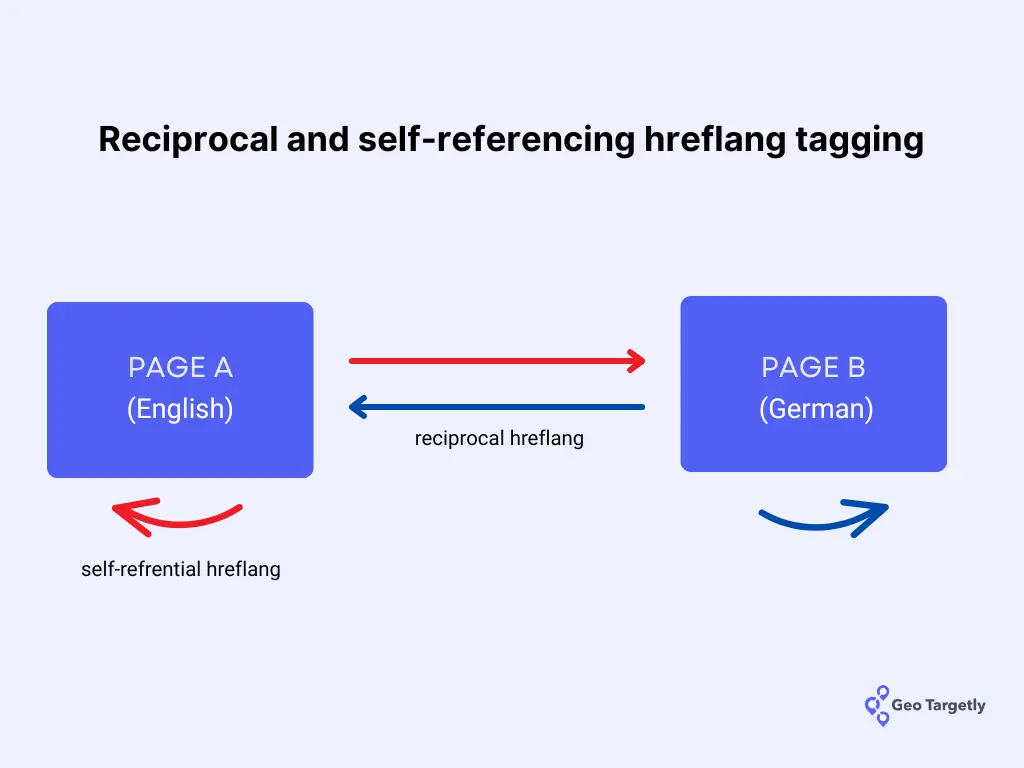
This is an illustrative example only. Replace the example URLs and codes with real, equivalent pages on your own site. The English, UK English, and German pages should each expose the same alternate set, including their own URL. If one page omits the reciprocal reference, Google may ignore that relationship.
Reciprocal Links and Self-References: The Essential Rules
The most important QA step is to review the entire alternate cluster. For every localized URL, check that it:
- Includes a hreflang reference to itself.
- References every equivalent alternate URL in the cluster.
- Is referenced back by those alternate URLs.
- Uses fully qualified absolute URLs with the correct HTTPS host and path.
- Points to accessible pages that are appropriate alternatives, not unrelated homepages or redirect destinations.
Google’s documentation allows some language variants to be omitted if maintaining a complete cluster is difficult, but the variants that are declared must have consistent bidirectional references to be processed as a relationship. Verify every page in a cluster rather than checking only the default page.
Hreflang, Canonical Tags, and Indexability
Hreflang and canonicalization serve different purposes. Hreflang describes alternate language or regional versions; a canonical indicates the preferred URL among duplicate or substantially similar URLs. Do not use a canonical tag to point every translated page to one language merely to simplify the implementation.
For pages that are intended to be independently available in search, review whether each locale’s canonical points to the appropriate preferred URL, often itself. Ensure the declared alternate pages are crawlable and return the expected status. A hreflang annotation does not override a noindex directive, robots.txt crawl restriction, broken URL, or conflicting canonical signal.
Use the Google documentation on canonical URLs alongside the localized-versions documentation when the same site has both localization and duplicate-URL challenges.
HTML, HTTP Headers, or XML Sitemap?
Google supports three ways to declare localized versions: HTML link elements, HTTP headers, and XML sitemap annotations. These methods are equivalent from Google’s perspective. Choose the implementation your platform can generate and maintain reliably; using all three at once usually adds maintenance work without an inherent Search benefit.
| Method | Best fit | Implementation notes |
|---|---|---|
HTML <link> elements |
Web pages where the template or CMS controls the document head | Every equivalent page needs the same alternate set. |
HTTP Link headers |
Non-HTML resources such as PDFs, or systems that manage headers centrally | Return the complete equivalent URL set consistently for each resource. |
| XML sitemap extension | Large sites that centrally maintain URL inventories and localization relationships | List each URL and its alternate annotations with the XHTML namespace. |
For sitemap implementation details, follow Google’s localized versions guide carefully. Avoid maintaining conflicting lists in the template, response headers, and sitemap unless there is a clear operational reason.
What Does x-default Do?
The x-default value identifies a fallback URL for users whose language or region does not match the other declared alternatives. It is commonly useful for a language selector or a chosen general version. It is optional and should point to a real, useful fallback—not a URL selected only because it exists.
Google explains that x-default annotations may also support URL discovery, but they are not a guarantee that the fallback page will be selected for every unmatched visitor. Read Google’s explanation of how x-default can help for examples.
Common Hreflang Mistakes
| Problem | Why it matters | How to fix it |
|---|---|---|
| Missing reciprocal references | Google may ignore the relationship between pages. | Generate the same alternate set for every page in the cluster. |
| Missing self-reference | The page’s own locale is absent from its cluster. | Include the current URL along with every alternate. |
| Wrong language or region code | The annotation does not describe the intended audience correctly. | Use supported language and region codes in the standard format. |
| Relative or malformed URLs | Alternate destinations may be ambiguous or invalid. | Use fully qualified absolute HTTPS URLs. |
| Links to redirects or errors | The declared alternative may not resolve to the intended page. | Check every alternate URL’s response and final destination. |
| One canonical across all translations | Conflicting signals can suggest that translated pages should be consolidated. | Review canonical intent separately for each locale. |
| Hreflang on unrelated content | The URLs are not equivalent language or regional alternatives. | Only group pages that serve the same underlying content purpose. |
| Conflicting implementations | HTML, headers, and sitemaps may disagree or become stale. | Choose a primary method or reconcile all generated outputs. |
A Practical Hreflang Validation Workflow
1. Build the URL mapping
Create a source-of-truth table mapping each content item to its equivalent language and regional URLs. Include the intended hreflang value, canonical URL, HTTP status, and whether the page should be indexable. Do not pair pages based only on similar slugs.
2. Verify every destination
Fetch each URL and confirm it resolves to the intended final page without unexpected redirects, errors, or accidental noindex rules. Verify the rendered HTML head or relevant response headers, depending on your chosen method.
3. Compare annotations in both directions
For each page, extract its alternate set. Compare it with the set on the other variants. Every page should list itself and its declared equivalents; mismatches should be reported for correction.
4. Validate canonical and robots signals
Check that canonical URLs are consistent with the intended locale strategy and that pages intended for search are not blocked or marked noindex by mistake. Treat hreflang, canonical, robots directives, and HTTP responses as a connected QA review, not independent checkboxes.
5. Keep the data synchronized
When a page is renamed, removed, translated, or moved to another locale, update the entire cluster. Remove dead alternatives, update redirects and canonicals as appropriate, regenerate the chosen hreflang output, then rerun the validation. A once-correct annotation set can become wrong after ordinary content maintenance.
Example QA Table
| Page | Self-reference | Alternates match cluster | HTTP/canonical checked | Result |
|---|---|---|---|---|
| English page | Yes / No | Yes / No | Yes / No | Pass / Review |
| UK English page | Yes / No | Yes / No | Yes / No | Pass / Review |
| German page | Yes / No | Yes / No | Yes / No | Pass / Review |
| Fallback URL (if used) | As appropriate | Present where intended | Yes / No | Pass / Review |
This table is a review template, not a report of a live implementation. Fill it with observed URLs and test results before signing off.
Hreflang Launch Checklist
- Each listed URL is a genuine language or regional alternative.
- Language and region codes are valid and reflect the intended audience.
- Every page includes itself and the equivalent alternate set.
- Alternate references are reciprocal across the declared cluster.
- URLs are absolute, use the correct HTTPS host, and resolve as intended.
- Canonical tags and robots directives agree with the localization strategy.
- The chosen HTML, HTTP-header, or sitemap implementation is consistent.
x-defaultis included only when a useful fallback is defined.- All language versions are revalidated after changes to URLs or translations.
- Unverified cases are documented instead of being marked as passed.
Conclusion
Hreflang is a relationship-management task, not just a tag-placement exercise. The reliable approach is to map genuinely equivalent pages, use accurate locale codes, keep alternate references reciprocal, and validate URLs, canonicals, indexability, and generated output together.
For broader technical foundations, see LogixScale’s Technical SEO Audit Checklist, Website Migration SEO Guide, and SEO Launch QA Checklist. These guides cover related technical validation work; this article focuses specifically on managing localized URL relationships.