
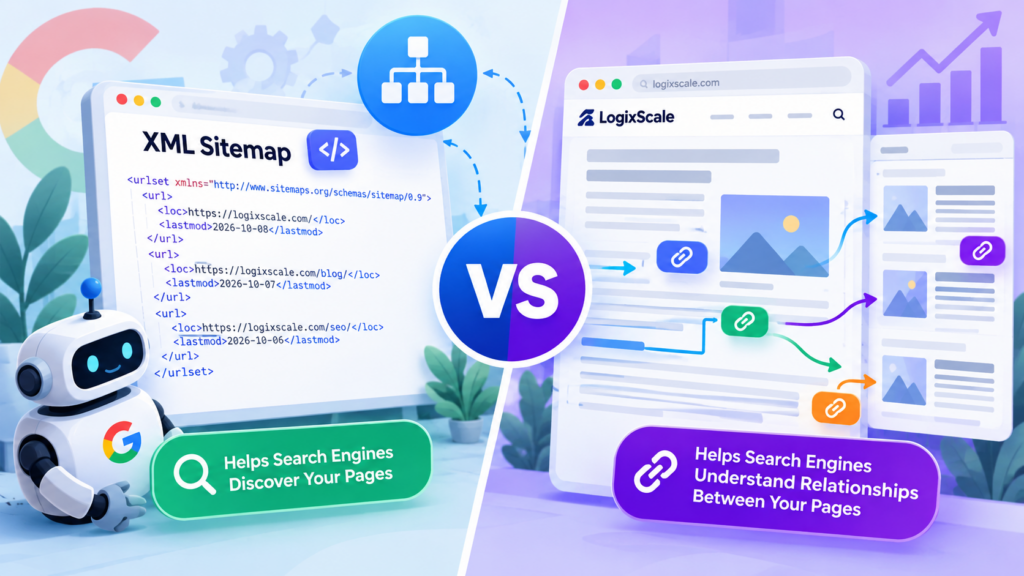
An XML sitemap and a site’s internal links both help search engines discover URLs, but they do different jobs. A sitemap provides a machine-readable list of URLs you want search engines to know about; internal links connect pages through the site’s actual information architecture and help crawlers and visitors navigate between them.
For technical SEO, the goal is not to choose one over the other. It is to make important, indexable pages discoverable through useful crawlable links, maintain an accurate sitemap, and investigate any mismatch between the two.
XML Sitemap vs. Internal Links: The Key Difference
| Area | XML sitemap | Internal links |
|---|---|---|
| Main role | Helps search engines discover URLs and understand which URLs you want included in the sitemap | Provides navigational paths and contextual relationships between pages |
| Format | Machine-readable XML file, often referenced by robots.txt or submitted in Search Console | Clickable links in navigation, breadcrumbs, body content, related-content modules and other HTML |
| Context | Lists URLs but does not explain the full topical relationship between pages | Anchor text and surrounding content can clarify what a destination is about |
| Indexing guarantee | No; inclusion does not guarantee crawling or indexing | No; a link does not guarantee indexing either |
| Best use | Communicate a maintained set of canonical URLs for discovery | Make important pages reachable and connected within the site |
What an XML Sitemap Should Contain
A sitemap is most useful when it reflects the site’s intended URL set rather than every URL the CMS can generate. For a typical website, that usually means canonical URLs for valuable pages and published content that should be eligible for search.
Review these points:
- Canonical URLs: include the preferred URL, not a duplicate or an alternate URL that canonicalizes elsewhere.
- Successful responses: investigate sitemap URLs that return errors, redirect unnecessarily, or are unavailable.
- Indexability: exclude URLs that are intentionally noindex or otherwise not intended for search indexing.
- Freshness: ensure newly published, updated, and removed content is reflected accurately.
- Valid XML: check that the sitemap and any sitemap index can be fetched and parsed.
- Appropriate scope: large sites may use multiple sitemaps grouped by content type, such as posts, pages, products, or images.
The optional lastmod value should represent a meaningful last modification, not be changed artificially just to suggest freshness. A sitemap is a discovery aid, not a substitute for maintaining the URLs themselves.
Why Internal Links Still Matter
Internal links give users and crawlers paths from one page to another. They also help establish how a page fits into a site’s subject structure. A page that appears in an XML sitemap but has no meaningful incoming internal links may still be difficult for visitors to find and may be poorly integrated into the site’s architecture.
Use ordinary crawlable HTML links with a real destination URL. Links should be accessible without requiring a crawler to submit a form or trigger a click-only JavaScript action. Choose concise, descriptive anchor text that tells readers what the destination covers.
For example, an article about crawl efficiency might link naturally to a SEO log file analysis guide, while a broader technical review can link to the technical SEO audit checklist. The links should help readers continue their task, not exist merely to increase link counts.
How to Audit Sitemap and Internal-Link Coverage Together
1. Collect the intended URL set
Fetch the sitemap index and its child sitemaps. Export the URLs and record their response status, canonical destination, indexability, and content type where your crawler can provide those fields.
2. Crawl the site from internal entry points
Run a crawl that follows internal links from the homepage, navigation, category or hub pages, and other accessible entry points. Export discovered URLs and internal inlinks. A crawler cannot reliably identify every orphan page from link-following alone, so compare its crawl with the sitemap and, when available, analytics or Search Console exports.
3. Compare sitemap URLs with crawled URLs
| Finding | What to investigate |
|---|---|
| In sitemap and found through internal links | Check status, canonical, indexability and whether the links are useful. |
| In sitemap but not found in the crawl | Check for orphaned pages, broken paths, JavaScript-only discovery, or a crawl configuration limitation. |
| Found through internal links but absent from sitemap | Decide whether the URL should be indexable and canonical. If it should, inspect why it is missing. |
| In sitemap but redirects or returns an error | Correct the sitemap entry and investigate the underlying URL or redirect mapping. |
| Non-canonical or noindex URL in sitemap | Align the sitemap with the intended canonical and indexing policy. |
These comparisons create a review queue, not an automatic instruction to add or remove every URL. Some pages are intentionally excluded from search; others may be valid but need a clearer internal path.
How to Fix Common Problems
Important page is in the sitemap but has no internal links
First confirm that the page deserves to exist and be indexed. If it does, add contextual links from the most relevant hub, category, service page, or related article. Use breadcrumbs or navigation when they genuinely improve orientation. Do not link every page from the global menu just to eliminate orphan reports.
Important page has internal links but is missing from the sitemap
Check whether the page is canonical, indexable, and returning a successful response. If it should be included, inspect the CMS sitemap settings, content type configuration, and any exclusion rules. Then regenerate or refresh the sitemap and re-fetch it.
Sitemap includes redirected or non-canonical URLs
Update the sitemap to list the preferred destination URL. Preserve necessary redirects for users and old external links, but do not use the sitemap as a list of historical URLs. For more detail, see LogixScale’s guide to finding and fixing redirect chains.
Pages are technically linked but hard to discover
Review depth and context. A useful page may need a link from a relevant topic hub or a supporting article rather than a distant, generic archive. For broader architecture guidance, read how to find and fix orphan pages and the seven-pillar SEO architecture overview.
Do Not Confuse Discovery With Indexing
Discovery, crawling, and indexing are separate stages. A sitemap can help a search engine discover a URL, and an internal link can provide another path to it, but neither guarantees that the page will be crawled immediately or included in search results.
If a valuable URL remains unindexed, inspect its response status, robots directives, canonical signals, content quality, internal-link context, and Search Console indexing information. Do not keep resubmitting the sitemap as a substitute for diagnosing the underlying issue.
A Practical QA Checklist
- Fetch the sitemap index and each child sitemap successfully.
- Confirm that sitemap URLs use the preferred canonical URL format.
- Check for error responses, unnecessary redirects, and accidental noindex URLs.
- Verify that important pages can be reached through crawlable internal links.
- Compare sitemap URLs with URLs discovered by a site crawl.
- Investigate valuable pages that appear in only one dataset.
- Review descriptive anchors and relevant hub-to-cluster relationships.
- Check sitemap freshness after publishing, removing, or migrating content.
- Re-crawl after fixes and document unresolved exceptions.
- Use Search Console to inspect indexing outcomes rather than treating sitemap submission as proof of indexation.
Final Takeaway
XML sitemaps and internal links are complementary parts of technical SEO. A sitemap communicates a maintained list of preferred URLs; internal links make the site’s content navigable and establish useful relationships between pages. When the two disagree, treat the mismatch as a diagnostic clue, validate the page’s purpose and indexability, and fix the underlying architecture or sitemap configuration.
For ongoing maintenance, combine sitemap validation with regular crawls, internal-link reviews, and indexing checks. That creates a more reliable URL-discovery workflow than relying on either mechanism alone.